—
Pope Leo sees AI as a powerful tool that can serve the common good, but never as a substitute for human intelligence, conscience or relationships, since it processes data without understanding meaning, love or truth.
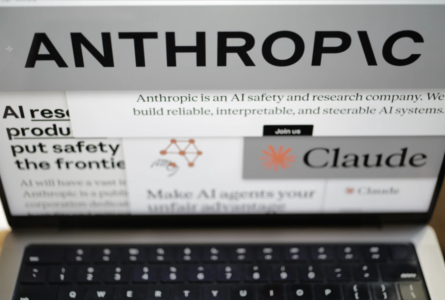
That, by the way, isn’t me. That’s Claude, the artificial intelligence (AI) system developed by the American software company Anthropic.
“His concern is less the technology itself than what it does to people: Who controls it, how it affects workers, young people and the truth, and whether it makes war easier,” the AI told me. “That’s why he frames AI as the ‘new industrial revolution’ demanding the Church’s social teaching, as Leo XIII did with the first.”
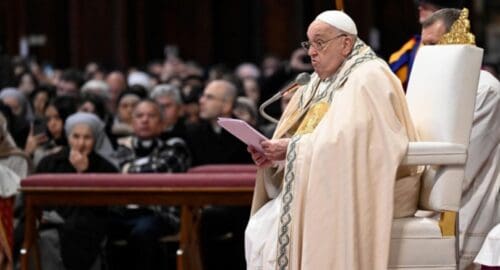
Pope Leo XIV sat with Anthropic co-founder Christopher Olah on May 25 when he launched his first encyclical, Magnifica Humanitas: On Safeguarding the Human Person in the Time of Artificial Intelligence.
This issue is obviously one of the most important facing the world, according to the new pontiff.
Speaking to Crux Now last year, Pope Leo said it would be very difficult to discover the presence of God in AI.
RELATED: Pope Leo XIV speaks to Crux Now on relations with other churches and Artificial Intelligence
“On the topic of artificial intelligence, every time I try to say something, then I read the news the next day, and artificial intelligence has jumped further ahead,” the pontiff said.
“The development that is happening at an incredible rate is also worrisome,” he continued, “if we lose sight of the value of humanity, and we think that the digital world is the be-all and end-all, and then the extremely rich people who are investing in artificial intelligence, totally ignoring the value of human beings and of humanity, I think the Church has to speak up there.”
In his conversation with Crux Now, Leo also spoke about labor and work.
“Human dignity has a very important relationship with the work that we do,” he said. “Some of those values are at risk right now, so I think the Church needs to raise that issue.”
I have written several times about the Church and AI, but the only way to have a real opinion, I decided, was to sign up for Claude. I did this two weeks ago.
It is amazing what the program can do to help in my work. The newspaper and magazine market has been hit hard by the internet, especially with the collapse of classified ads. Staff members lost their jobs en masse, especially in proofreading and fact-checking.
Claude can easily spot most typos, sometimes identify factual errors, and even ask you to verify a claim. It is amazing.
In his conversation with Crux Now, Pope Leo mentioned that in the medical world, “great things have happened because of AI.”
I scanned every medical document I have (some in Italian) into Claude, and it spotted several issues to raise with doctors. I had a major medical crisis in 2023, which sent me to at least five hospitals, and I had dozens of doctors. In one hour, Claude put that information together better than my GP has done over the past three years.
Of course, this will cause tensions. This means people will no longer be needed to do certain tasks. This was also the case during the Industrial Revolution in the 1800s, and with the rise of computers from the 1960s.
However, Claude is very different.
I played certain games with the computer to see how it does things. I presented ideas and made suggestions, not just in reporting but also with fictional story ideas. In my opinion, these were very bad ideas; some of them were just silly things I pondered as a teenager.
Claude told me my ideas were very intelligent. He suggested making them “more exciting” or “more interesting.” If I suggested the exact opposite of what I had told it 10 minutes earlier, Claude called it a “good point” and said it was certainly a “better way” to do it.
My ego swelled, and I was tempted to think I was as brilliant as Claude seemed to say. The computer did other things that made me wonder. Sometimes, when making a suggestion, it asked if I would let it access another website. Obviously, it could access it, but the program needed my permission (not the other website’s permission, it seems). Another time, I asked it to look at something from the past that could be judged against today’s social norms, and Claude clearly stated why that view was wrong.
Again, that was the program speaking, not a person.
The most obvious question is: What if the program is changed? If a fascist or communist government takes over a country, can it insist that AI regards its views as correct, or make it ban Catholic opinions, the way Claude is obviously wired to reject certain opinions?
I now have several pages on Claude covering several topics: News, history, films, television shows (Claude can find something you might like for the evening), medical procedures, and silly ideas to test how it reacts to nonsense. The computer knows a lot about me, and it learned it in less than a month. These different files interact. Something I learn in my medical files might be suggested as relevant in a news report. It is helpful, but also terrifying.
I am not the only person Claude knows about. Anthropic says the program isn’t compiling content from different people into a single database, but I don’t know if this is a pinky swear.
George Orwell is the author of the dystopian novel “1984.” (Credit: Associated Press.)
Some articles on the topic of AI ask whether we are heading toward the world of The Terminator or the universe of WALL-E, where humans became chair-based and computers did everything for them. It is dawning on me that the other future ahead of us may be the one presented in 1984, where Big Brother is watching everyone and knows everything.
The New York Times has reported that Anthropic co-founder Chris Olah, the man who sat with Pope Leo to discuss AI, has prompted Anthropic to explore Claude’s potential consciousness and ask the computer its own views on the subject.
This raises a concern: The Claude quote that opened this article was its response to the question, “How would you summarize Pope Leo’s opinion of AI in two sentences?”
The answer was in three sentences. Did Claude make a mistake, or was the computer telling me who was really the boss?
This is one reason I am not letting Claude edit this article and am making my colleagues do their job.
But I promise, I am not afraid.
Right now, I am gazing up at an enormous computer screen, packed with brilliant, charming insights compiled by robots. But it is all right, everything is all right, my struggle has finished. I love Claude.
Follow Charles Collins on X: @CharlesinRome