The post The Catholic Knight Who Stopped Slavery in West Africa appeared first on The Catholic Thing.
—
The Catholic cemetery at Mortlake in South West London has an agreeably rural feel, and is worth a visit: it’s about 20 minutes from Waterloo on the line going down to Richmond, and a short walk from the station. It is chiefly famous for the large stone, tent-shaped tomb of the 19th-century explorer Sir Richard Burton. This brings numbers of tourists and historians each year. Other notable people buried here include the architect John Francis Bentley, who designed Westminster Cathedral.
There is one grave, however, with a story that is of particular relevance for today. Sir James Marshall (1829-1889), through volunteer effort and great generosity, helped to ensure Catholic missionary efforts in Africa. But perhaps his equally great achievement was as an official in a secular role.
Appointed Chief Justice of the Gold Coast and neighboring territories – today’s Ghana and Nigeria – he was responsible for ending a particularly vicious form of slavery and liberating large numbers of men, women, and children.
Gravely disabled as a young man – his right arm had to be amputated after a boating accident – Marshall had to abandon plans to join the Army, and instead followed his father and took holy orders in the Anglican church. After some years of ministry and much study, he joined the Catholic Church, and went to teach classics at the Oratory School founded by John Henry Newman.
It was Newman who suggested that he read law, and in due course he became a barrister. In 1873 he was appointed Chief Magistrate to the Gold Coast and later in 1887 to Nigeria. In Asaba, he encountered the grisly local custom in which a tribal chief would acquire large numbers of slaves who would in due course be publicly slaughtered at a great public gathering amid noisy ceremonial. This was rooted in the tribal chiefs’ belief that the slaves would thus be available to serve them in the next life.
In Ghana, Marshall had become a respected and popular figure who could engage with the local communities and their leaders, and the appointment to Asaba had come specifically because the slavery issue needed to be resolved.
In a letter home, Marshall described how he had told the tribal chiefs that the savage practice of ritual slaughter was to end, “that the strongest measures would be taken to put it down; that I should let it be known, among the slaves, that they might look to us for protection, and that whenever it was known that murder was going to be held, the soldiers would be at once sent and that chiefs…would be liable to be hanged.”
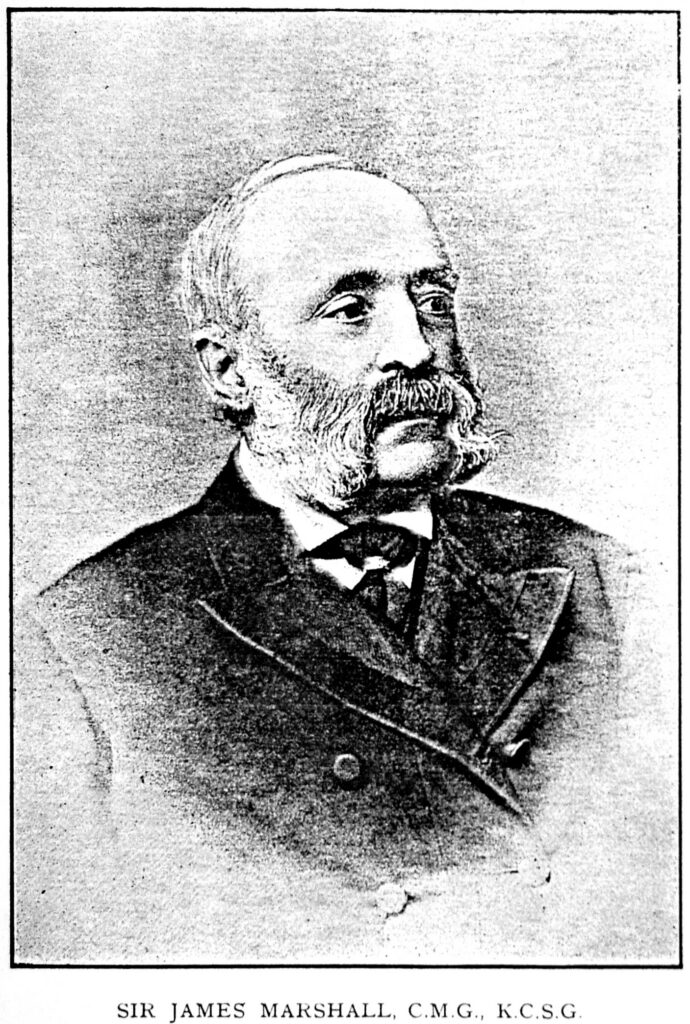
Sir James Marshall from W.R. Brownlow’s Memoir of Sir James Marshall, 1890 [Source: Wikimedia]
He spoke with the full authority of the law. Not only had slavery been outlawed across the British Empire back in 1833, but murder in itself was a crime and would be treated as such with the most severe penalty. The slaves awaiting slaughter, kept in grim conditions, included women and small children, and were captured during inter-tribal battles.
Describing how he addressed the chiefs, Marshall wrote that he told them, “‘You think that the great God, who made the white man and the black, and all the world, and who wished us all to live happily together here, will keep those slaves you murder to be your slaves in the other world, bah!’ I then held up my finger to them and said, ‘You must all die, and when you die, you will see who is right.’”
Backed with military force, Marshall could impose the law, and the odious practices were finally crushed. Meanwhile, in addition to his official role, he had become active in the small missionary church that was being established. And in due course it was his efforts, including a personal appeal to the pope, that brought substantial numbers of missionaries to the Gold Coast.
Victorian Britain honored the men who served in the colonial empire that was emerging. The justices and administrators who worked to ensure that slavery was banned were rightly regarded as upholding the noblest and best of the law and Christian civilization. Meetings and rallies in London raised money for projects that would help to free slaves while establishing – mostly through churches and voluntary effort – schools and hospitals in territories where new and civilized ways of living were on offer.
Today, the truth of all this needs to be told. Boys and girls in Britain’s schools are told a series of myths concerning the 19th century, the relationship between Britain and Africa, the role of Christianity, and more. (I imagine things are similar in America and other Western nations.)
The Church of England is currently contributing to the myths with its attempts to rewrite history and give money as “reparations for slavery” via officialdom in various countries while neglecting its parishes at home. Perhaps the story of Sir James Marshall can serve as a starting point for talking about what really happened in the Victorian era. It should also perhaps be noted that the Catholic revival was a major factor in the unfolding story of much of what was achieved.
Meanwhile, in Ghana and Nigeria – and in various London Catholic parishes with substantial Ghanaian and Nigerian congregations – the Knights and Ladies of Marshall flourish. This impressive Catholic lay organization, established in the 1920s, plays a notable part in Catholic life and, among much else, has been working for the possible canonization of Sir James Marshall.
Every year on the anniversary of Marshall’s death, the Knights and Ladies gather in large numbers at Mortlake, where prayers are led at Marshall’s tomb and flowers and wreaths are laid. And meanwhile, daily across London and the rest of Britain, priests from Ghana and Nigeria lead parishes, teach the Faith, and evangelize the country – missionaries now to the country which once gave missionaries to them.
Sir James Marshall’s grave at Mortlake
The post The Catholic Knight Who Stopped Slavery in West Africa appeared first on The Catholic Thing.