—
What does it mean to be the head of the Holy See? Or the head of the Vatican City State?
That question has been driving a good deal of discourse over the past two weeks, ever since U.S. Ambassador to the Holy See Brian Burch gave an interview to the New York Times, but the question has remained largely unstated as a driver of the controversy.
The episode presents what folks in education call a “teachable moment,” an opportunity to shed some light and – hopefully – take down the temperature just a little.
That’s eventually going to require a bit of breezy history – but first, the details of the dust-up.
The July 9 NYT article by Elizabeth Dias and Motoko Rich said Burch argued that when the pope spoke out against the U.S.-Israeli war against Iran, he was not doing so as the leader of the Catholic Church, but only as the sovereign political leader of the Vatican City State.
To be perfectly frank, it is hard to analyze what Burch said about pope’s statement against the Iran War, because the article didn’t give the exact quote, but only indirectly reported his remark.
The July 9 story did, however, quote Burch directly as saying: “When the pope acts as the sovereign leader of the Holy See, he is coequal with world leaders.”
The first thing to note is that the Vatican City State is not the same thing as the Holy See. The point is not an academic one, nor is it semantic nitpicking.
The Holy See is the body which sits at the United Nations and has diplomatic relations with other nations.
Even the “extraterritorial property” the Vatican holds in Rome is under the jurisdiction of the Holy See, not the Vatican City State (this includes some property adjacent to Vatican City, including parts of the Paul VI Audience Hall).
The pope meets with officials of various international organizations – many of which are in Rome – and the papal ambassadors to the UN offices in both New York and Geneva make speeches all the time, often about things like fishing laws and working hours.
A distinction with a difference
Vatican City State is a sovereign territorial micro-state. The Holy See is the sovereign “personality” of the papal office recognized under international law. The pope heads both, and journalists use “the Vatican” as non-technical shorthand, but the difference between them is real and important.
Burch, for example, is the U.S. Ambassador to the Holy See, not to the Vatican City State.
In any case, an essay from Andrea Tornielli, the Editorial Director of the Vatican’s Dicastery for Communication, followed the publication the NYT piece and was widely construed as a rebuke – albeit a mild one – of the ambassador’s comments.
Tornielli – whose offices happen to be in one of the Holy See’s extra-territorial holdings – didn’t specifically name Burch in his article, which was carried by the Holy See’s official Vatican Media outlet, but he did allude strongly to the ambassador’s remarks.
“Even when he speaks about war and peace, migration or how to remain human in the age of artificial intelligence, the Successor of Peter remains, above all, a spiritual leader,” Tornielli wrote.
“The fact that the Bishop of Rome, by virtue of the Lateran Pacts of 1929 that resolved the ‘Roman Question,’ is also the sovereign of the world’s smallest state—less than half a square kilometer in the heart of the Italian capital—does not mean that he acts or speaks as a politician when addressing issues concerning the affairs of humanity,” Tornielli wrote.
The “Roman Question” is an expression that carries a lot of weight.
What is the ‘Roman Question’?
The issue it names arose nearly 200 years ago, when what is now Italy was made of several states, including The Papal States, which was ruled by the popes.
As the movement for Italian unification began to gather steam, European leaders debated what to do about the territory ruled by the leader of the Catholic Church, because the crowned heads in Europe mostly didn’t want to upset their own Catholic populations.
During the period of the Papal States – which lasted over 1000 years – popes most certainly acted as political leaders. They dealt with taxes, tackled crime, and even waged war.
In those days, most bishops were appointed by their governments. Internal issues were rarely addressed, except during the Protestant Reformation and the revolutionary upheavals it unleashed.
After the nascent Kingdom of Italy captured the city of Rome in 1870, the pope was left without any territory over which to rule, a situation that persisted until the Lateran Pacts that established the Vatican City State in 1929.
Bl. Pius IX, who was pope in 1870 when the city fell to the Italian army, famously described himself as a “prisoner in the Vatican,” and refused to recognize the new kingdom, which had made Rome its capital.
Three successive popes after Pius IX came and went before the situation was resolved.
The Holy See, however, still had ambassadors through all that time and continued to be recognized as a sovereign power by several of the world’s nations.
“Any glorification or exaggeration of the pope’s role as head of state, any emphasis on the importance of this role, is therefore misleading because it comes at the expense of his one true mission as universal Shepherd,” Tornielli wrote in his article.
Everybody has a job to do
Tornielli described the pope as “[a] shepherd who speaks to Catholics, Christians, believers, and all people of good will with the sole intent of proclaiming the Gospel—his message of love, brotherhood, and ‘unarmed and disarming’ peace,” and that’s all right, too.
It’s fair to say, however, that Tornielli is somewhat over-simplifying the role of “the Vatican” in world affairs.
It’s also fair to note that objections to Burch’s remarks have tended to give his role as a representative of the U.S. government short shrift.
As for Burch, he has to represent the United States government, which ended its consular relations after the Papal States fell in 1870 and only established full diplomatic relations with the Holy See in 1984.
Over the last 40-plus years, most U.S. ambassadors haven’t really discussed politics – at least, not publicly – and have preferred mostly to meet with American Catholics in Rome, including those that worked at the Vatican in various capacities.
Ambassador Jim Nicholson, who was sworn in shortly after the September 11, 2001, terrorist attacks, worked hard to promote the U.S. position in the resulting wars, but his activism wasn’t continued after he left Rome in 2005.
There’s a real sense in which Burch ought to be seen as trying to do what Nicholson did during his time in Rome – though his work is made more difficult given U.S. President Donald Trump’s continued attacks on Pope Leo XIV.
Said simply, it is important to remember who Burch works for, and what job he has to do.
The article in the New York Times said the ambassador saw Trump’s social media outburst as an example of the president “negotiating” to “secure the support of the Holy See around his efforts to protect the world from nuclear catastrophe.”
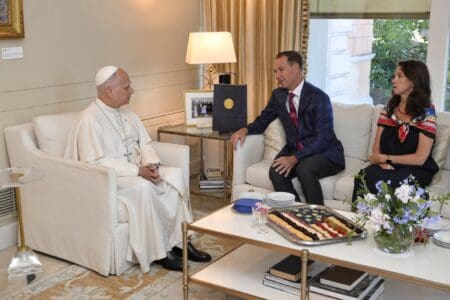
Although published after Pope Leo’s July 4th dinner with the Burch family, the newspaper’s interview with Burch was conducted over two sessions in June.
The pope’s friendly house call over Independence Day weekend shows that Leo wants a good relationship with the U.S. government, even during an administration has volatile as Trump’s, which will come to an end after the 2028 presidential election.
To be fruitful, that relationship requires real clarity on who’s who and what’s what, especially regarding the place and role of the Holy See in international affairs and the job of ambassadors in general, including the one from the United States.
Follow Charles Collins on X: @CharlesinRome