Let me put it this way: I have rarely experienced anything that has had such a massive impact on my spiritual life as my encounter with the Old Mass. And this is coming from someone who has been incredibly blessed his whole life when it comes
—
Why try the TLM?
Let me put it this way: I have rarely experienced anything that has had such a massive impact on my spiritual life as my encounter with the Old Mass. And this is coming from someone who has been incredibly blessed his whole life when it comes to the Faith.
My parents raised me Catholic; my family prayed the Rosary together; I was an altar server in my childhood; two brothers of my grandfather were priests; I received the sacraments regularly, took trips to Rome, went on pilgrimages to places such as Medjugorje, and have friends who are Jesuits and Dominicans and a brother in the Legionaries of Christ.
My wife and I spent about ten years in the charismatic community of Emmanuel. And then, one day, in my early fifties, I moved to Rome and got to know the Traditional Latin Mass, and everything changed. It was the beginning of a complete transformation of my personal life, my life with the sacraments, and my personal relationship with Christ.
Looking back, I can explain all of this only as a fruit of this liturgy and the world surrounding it. It was as if a page had been turned—and not just for me but for my wife and my children too.
Strangely enough, it wasn’t the beauty, the Gregorian chant, the incense, or the ornate robes that drew me in. All the elements that people usually see as the main reason for attending this form of the liturgy had little effect on me. No, it was the silence.
I was dragged to my first TLM in Rome by my wonderful wife.
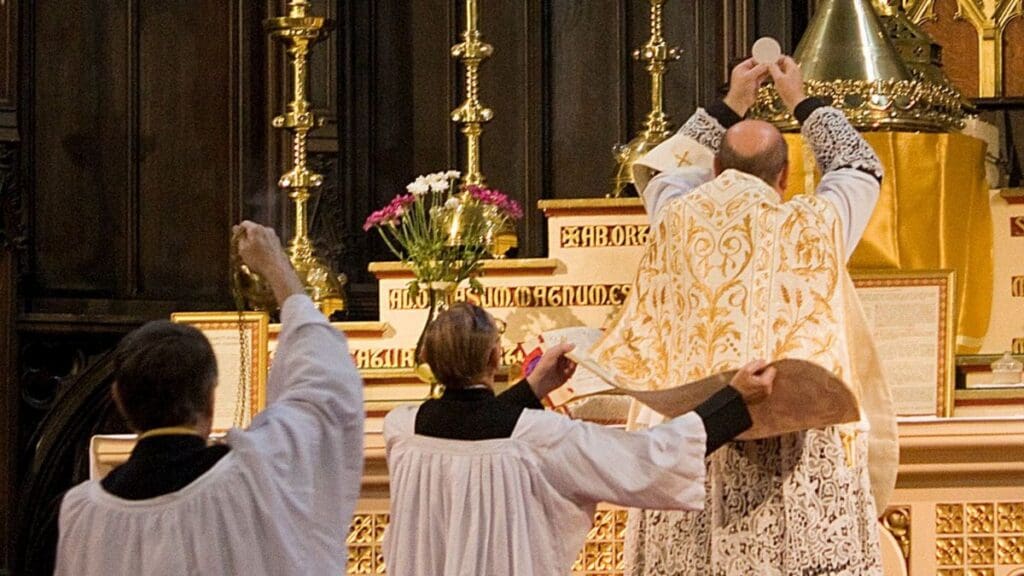
So there I was, frantically flipping through the pages, trying to keep up, and I suddenly found myself struck by the silence. The Sanctus had just ended, and instantly the church grew completely quiet. The priest prayed and did something on the altar that I could not see, and it stayed silent. Everyone was kneeling, not much seemed to be happening, it felt as if the silence was closing in on me, and then it was interrupted by bells, to indicate the Consecration, followed by more silence.
“What is this? What is this?” I thought, baffled, just like Merlin the wizard in Excalibur.
For me, this stretch of silence was the gateway drug. In my humble opinion, it was the first time that I was able to experience the incredible moment of the Consecration. I was used to the Mass of today, in which the time between the homily and the Consecration tends to be very short. Right before and after the Consecration, the faithful are expected to utter responses and sing.
But here, everything continued in silence after the Consecration. That really spoke to me.
It was the foreign, the unknown, that drew me to the Old Mass. I was lucky enough to find a priest who let me, an old family father, be an altar server during his morning Mass on a side altar a couple of times. This was the second big step for me.
It was an incredibly humbling experience, and the patience and humor of the priest prevented it from being even more embarrassing. I learned that being an altar server in the TLM is something complex and challenging, something that must be learned over a long period of time.
Every gesture is a way to enter more deeply into the mystery of the Holy Sacrifice of the Mass.
Not only is the altar server able to help the priest, but he is an integral part of the Mass. He has to know the responses, either by memorizing them or by reading them from a little book or card until they stick.
By moving around the sanctuary in a devout and dignified manner, he can inspire the faithful to enter into devotion and prayer more deeply. For all these reasons and many more, my weeks as an altar server have been incredibly helpful.
After sharing so much enthusiasm for this form of the Mass, I have to be prepared to answer the following question: “Is the TLM for everyone?”
My own experience (and that of my family) makes me want to say yes. But there are many reasons why people raised in the Novus Ordo might have mental blocks that prevent them from accepting this form—for example, the Latin language. Others look for more interaction with other Catholics when they go to Mass. Others, again, do not seek silence and contemplation in liturgy and prefer more personal involvement.
One thing I would say is that we seem to have forgotten that the Catholic Mass is not—as in many Protestant denominations—primarily about interpersonal relationships and community. The first and deepest encounter in the Mass is with God himself, our Lord and Savior, in the real renewal of His sacrifice on the Cross and Holy Communion.
And a word on community: The community of Christians is made up not only of the people present at Mass but also of all the angels and saints, who are present in every Mass.
This article is an excerpt from Eduard Habsburg’s book, “Discovering the Latin Mass: A Travel Guide for the Curious.”