The post The Catholic Church’s American Moment appeared first on The Catholic Thing.
—
This year is special for American Catholics in two ways. First, there’s the upcoming 250th birthday of the American Republic on July 4, 2026. But there’s another anniversary to celebrate. Today is the first anniversary of the election of Leo XIV, the first pope to hail from the United States.
I’m from Bratislava, Slovakia, and have long had a keen interest in all things American Catholic. I find myself thinking a lot recently about the role that American Catholicism plays not only inside the United States, but across the world.
In particular, I recall Fr. Richard John Neuhaus and his 1987 book The Catholic Moment: The Paradox of the Church in the Postmodern World. While that ambitious volume is concerned with the Catholic Church at large, the book captured a special moment in the life of the Catholic Church in the United States.
Neuhaus argued that, by the late 20th century, American Catholicism had matured. No longer a marginalized immigrant faith, it had institutional depth (schools, universities, media), intellectual firepower (theologians, philosophers) and growing cultural legitimacy. This created a rare “moment” where Catholic thought could step into the public as a serious moral framework for society.
Whether and how fully that opportunity was seized can be debated. My sense is that, despite many challenges, Catholicism has played a transformative role in recent American history and is far from finished. And my larger contention is that 2026 marks the American moment in the history of the Catholic Church.
I have been traveling a lot across Europe in the past several years. I got my first degrees from Cambridge and Oxford, and recently a doctorate in Prague. I have been teaching undergraduates in Budapest, Krakow, and Bratislava. I attended a dozen conferences and summer schools for Catholic students and young professionals across Central and Western Europe.
I have a pretty good grasp of the up-and-coming generation of European Catholics. And I can tell you: Where there is life, where there are vibrant, engaged groups of young Catholics – they are, as a rule, plugged into contemporary American Catholicism.
One telling example: I recently gave a course on the history of modern Slovak Catholicism. At the end, when it came to evaluating the heroes and villains of that history, the class was united in relatively uniform evaluation of figures from the 20th century. But when we spoke of the present, views diverged widely. In short, the only thing that the class was able to agree on was that there’s now much chaos in Slovakia, and indeed across Europe, regarding how one’s Catholic faith is to translate into a coherent vision of public or political engagement. There is no one to look up to.
But one participant raised her hand and said: “Well, the one thing I’d recommend to everyone to sift through this chaos is the American podcast ‘Pints with Aquinas,’ featuring Fr Gregory Pine OP and Matt Fradd.”
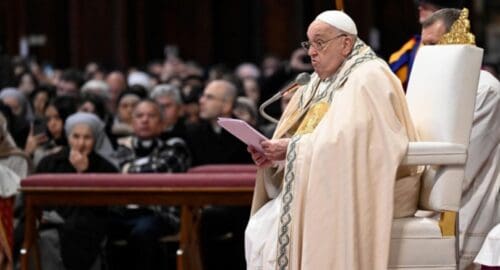
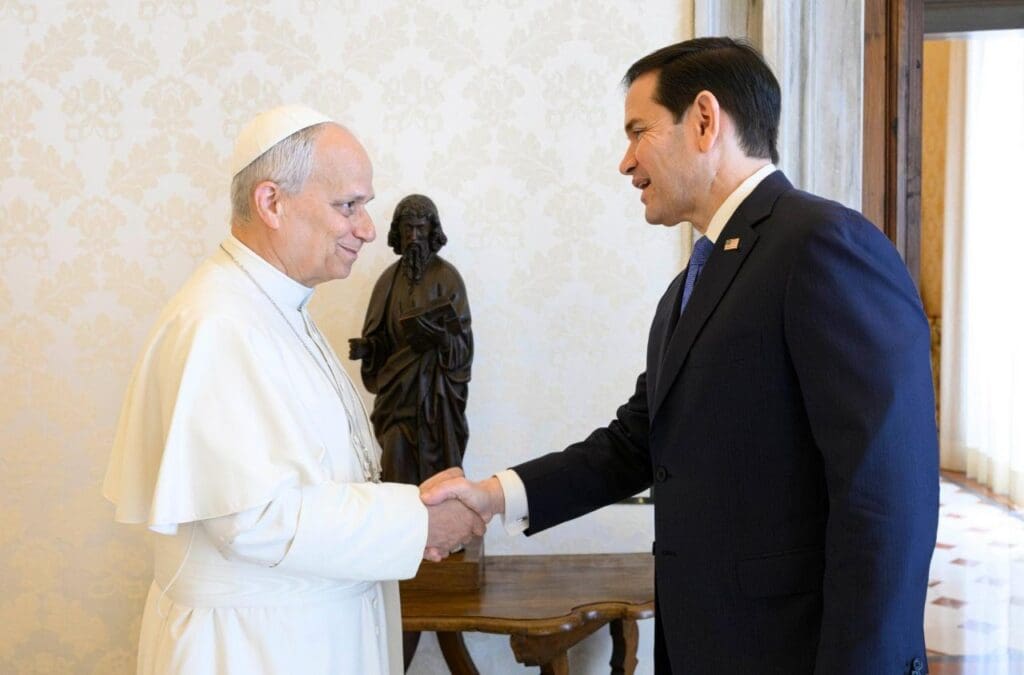
Pope Leo XIV shakes hands with US Secretary of State Marco Rubio on May 7, 2026 [Source: Vatican Media]
I see this frequently everywhere I go across Europe among millennials and Gen-Z: conversions induced by listening to Bishop Barron’s sermons; or transformative experiences of Great Books programmes inspired by the revival of classical education in the US; engaged couples preparing for the wedding day by reading Christopher West, Jason Evert or the von Hildebrands; (who were male groups doing the Exodus 90 Lenten spiritual program for the third or fourth year in a row), and increasingly, everywhere, subscribers to the world’s most popular and thoroughly Catholic prayer app, Hallow.
In the circles of Catholic staffers and policy wonks in Brussels and on the national level, it is hard to avoid alumni of Arete Academy, the leading international training programme of Alliance Defending Freedom, which, of course, is a joint effort by Christians of various denominations, but which has earned its status thanks to the longtime leadership of its founding CEO Alan Sears, an American convert to Catholicism.
This American moment has particularly taken off since the pandemic. Many American Catholic ministries took their activities online. I remember first watching the Thomistic Institute productions by the Washington D.C. Dominicans around Easter 2021, when, in many countries, including Slovakia, churches were, sad to say, shut down even during the Holy Week.
There are many factors that fuel the influence of American Catholic thought in places like Slovakia and around the world: new technologies, the extrovert American soul, the culture of philanthropy, among others. But at heart, the primary reasons are theological.
American Catholicism is deeply evangelical, not as in Protestant theology, but a deeply intuitive and creative embrace of the Gospel’s call to go forth and make disciples of all nations. I first came across the term evangelical Catholicism in George Weigel’s writings. John Paul II’s call to New Evangelization has been taken up more seriously in the United States than in any other country.
Yet I think that this deep evangelical orientation of American Catholicism predates that great pope. If Bishop Robert Barron is now the Field Marshal of the evangelical Catholic forces trying to conquer online space, the grand strategy was perhaps first pursued by Archbishop Fulton Sheen, who died in 1979.
Which brings me back to 2026, when, as has recently been announced, this great American Catholic shepherd will be beatified. That’s the third big date on the American Catholic calendar this year. So, what to make all this in light of what I call the Catholic Church’s American moment?
First, on the anniversary of the papal election, let’s hope that the Holy Father decides to lean more on and amplify the good spiritual fruits coming out of his native land today.
Second, with the anniversary of the Declaration of Independence, let’s give thanks for the American experiment in ordered liberty and pray that the Church in the United States can sustain that experiment and its preeminent role internationally in our multipolar era.
And finally, as Fulton Sheen joins the ranks of the Blesseds and saints, let us give thanks for all the spiritual fruit coming from American Catholicism today.
And let us pray that it continues to grow.
The post The Catholic Church’s American Moment appeared first on The Catholic Thing.