The post St. Peter’s Basilica: In the World for the World (and of the World) appeared first on The Catholic Thing.
—
Saint Peter’s Basilica is the world’s most Catholic thing.
The image of it, in a news video or a movie scene, stands for the Catholic Church. EWTN, the world’s largest religious network, includes just the silhouette of Michelangelo’s dome, sufficient by itself to manifest Catholic identity.
Pope Leo XIV concluded his long homecoming trip to South America – including Argentina, in place of the homecoming trip never made by Pope Francis – in time to be back at St. Peter’s on Wednesday, the four hundredth anniversary of the dedication of the basilica.
It is not the most important liturgical site in Rome – St. John Lateran is Rome’s cathedral. But it is the largest and most impressively decorated. Every church serves as an analogous sacrament, a visible sign of the invisible reality of the Church. St. Peter’s, from cupola to colonnade, does so on such a grand scale and with such surpassing beauty that the whole world recognizes it.
It manifests the reality of the Church, in the world for the world, to point worldly eyes toward heavenly things. And it is very much of the world, touched by the various vainglories and venalities of the very peak of the High Renaissance. Like Dante for the Italian language, or Shakespeare for English, St. Peter’s is the summit of sacred architecture and art.
The pilgrim knows that he is visiting the best that has ever been built – and the best that ever will be. It is of the world not only in its human origins, but of the world in that it is the best the world has to offer. Nothing greater will be seen this side of Heaven; indeed, it exists precisely to allow Heaven to be seen from this side of earth.
At four hundred years, St. Peter’s is not even half as old as its predecessor, the first St. Peter’s, which lasted more than a thousand years. The earlier church’s origins under the worldly power of Constantine reflect the Christian insistence that it supremely matters where God traced his finger in the world. In 326, thirteen hundred years before the current St. Peter’s dedication, Constantine and his mother, St. Helena, gave the orders to build the Church of the Holy Sepulcher in Jerusalem.
The first St. Peter’s was built precisely over Peter’s relics, venerated on the same Vatican hill where he was crucified. It was the triumph of particularity over practicality. Building St. Peter’s over St. Peter meant leveling a good part of the hill itself, when nearby there was already a convenient imperial circus, flat and ready. But Peter was not crucified there, and the difference between here and there is the story of salvation.
By 1503, when Pope Julius II was elected, the papacy was in bad shape. Pope Pius III, his immediate predecessor, reigned for only twenty-seven days, fewer even than Blessed John Paul I in 1978. They called Julius il papa terribile, meaning both fierce and warlike. He was, though, not as terrible as Alexander VI Borgia, who died that same year before Pius III.
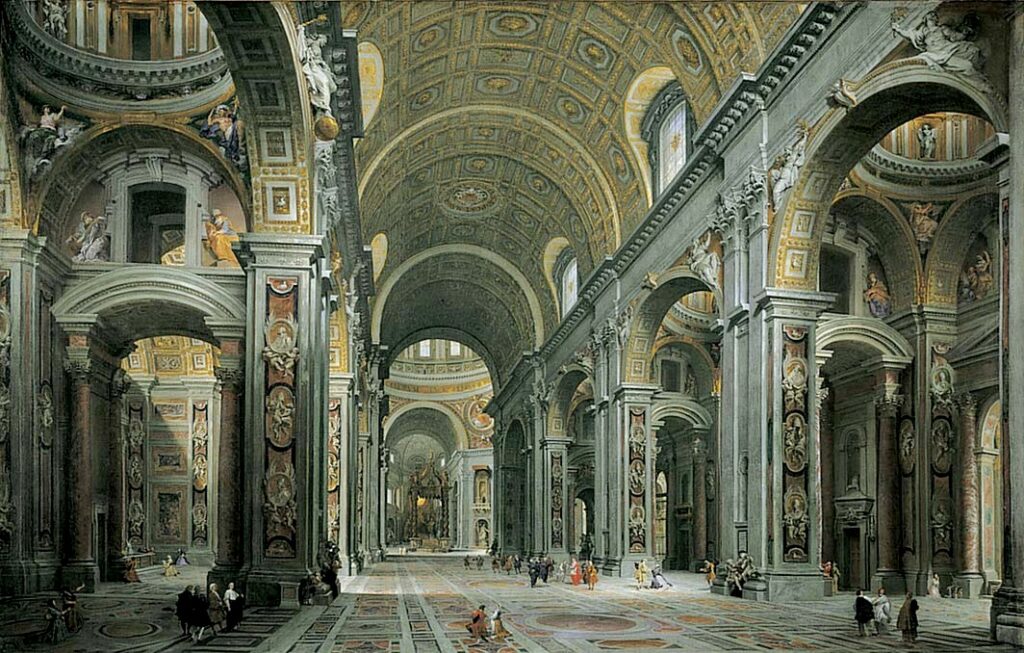
Rome: The Interior of St. Peter’s by Giovanni Paolo Panini, 1735 [The National Gallery, London]
Old St. Peter’s was in bad shape too, dilapidated after a millennium. Replacing such a venerable edifice seemed impossible. Very much like how only Mussolini could bulldoze the buildings around St. Peter’s to create the magnificent Via della Conciliazione, Julius gave the order to demolish the old and build anew.
It takes a certain tyrannical cast of mind to do such things; and the mind of Julius, it is said, thought of Julius Caesar when he chose his regnal name. Upon his death, a fierce satire would appear about this aspiring Caesar – Julius exclusus, originally anonymous but later revealed to be the work of no less than Erasmus himself – about Peter closing the Gates of Heaven upon his successor Julius. God builds with crooked timbers and flawed marble.
Julius laid the foundation stone in 1506, two years before he sent Michelangelo to work in the Sistine Chapel and Raphael to attend to the nearby rooms. Bramante would be the master architect, the first of a series, including Raphael and Michelangelo, over the next century until Maderno completed the imposing façade.
There, the vanity of too many popes was stamped forever, with the central panel of the 1612 inscription honoring not St. Peter but “Paul V Borghese.” The “Prince of the Apostles” is shunted off to the side. The current façade of St. John Lateran, completed a century later, is happily correct. “Christo Salvatori” is in the center, with Clement XII off to the side.
Gian Lorenzo Bernini would take over as architect in 1629, serving for fifty years. He gave St. Peter’s its heart – the baldacchino over the papal altar, which is itself over the tomb of Peter; its head – the soaring Altar of the Chair in the apse under the Holy Spirit window; and its arms – the keyhole-shaped colonnade, which extends the Church’s mission to the whole world. The concept of genius loci has its roots in both Roman paganism and architectural design; no place on earth was the locus of as much genius as St. Peter’s.
That genius included, in the estimation of R. A. Scotti, “the power of Bramante, the grace of Raphael, the clarity of Michelangelo, and the theatre of Bernini.”
Scotti entitled her history of St. Peter’s simply Basilica. It is a class of one. She notes that the audacity of the construction, which “makes the heart stop and the soul soar,” was only achieved at “huge sacrifice”:
The Renaissance popes hocked the family jewels in the name of art, begged, borrowed and splintered the Christian Church to build the Basilica. The details changed, but the ideal remained constant – to construct a metaphor in stone for the leap of faith that is at the heart of the gospel of Christ.
Almost right. St. Peter’s is not about leaping as much as standing on solid, stunning, sacred ground. And it is not a metaphor. It is a sacrament.
The post St. Peter’s Basilica: In the World for the World (and of the World) appeared first on The Catholic Thing.