“I am close to all the Lebanese people at this time of grave trial,” the pope said on March 11.
—
VATICAN CITY — Pope Leo XIV on Wednesday remembered Father Pierre El Raii, a Maronite priest who died after being wounded in an Israeli bombing in southern Lebanon, and described him as “a true shepherd” who remained with his people despite the war.
El Raii was killed on March 9 while going to the aid of a parishioner wounded in a earlier attack, according to Father Toufic Bou Merhi, a Franciscan of the Custody of the Holy Land, who spoke with Vatican media.
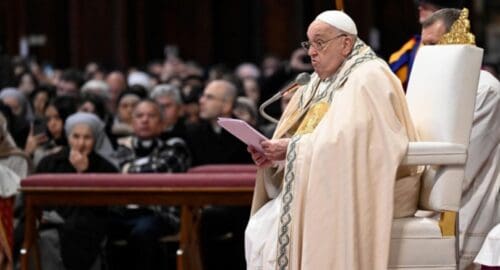
At the end of his weekly general audience in St. Peterʼs Square, Leo commented on the March 11 funeral of El Raii and the war affecting villages in southern Lebanon.
“I am close to all the Lebanese people at this time of grave trial,” he said.
“In Arabic, ‘El Raii’ means ‘the shepherd,’” the pope said.“Father Pierre was a true shepherd, who always remained close to his people, with the love and sacrifice of Jesus the Good Shepherd. As soon as he heard that some parishioners had been wounded by a bombing, he rushed to help them without hesitation. May the Lord grant that his blood shed be a seed of peace for beloved Lebanon.”
In his appeal, Leo also called for prayers for peace in Iran and throughout the Middle East, “especially for the many civilian victims, including many innocent children.”
“May our prayer be a comfort to those who suffer and a seed of hope for the future,” he said.
A Church open to others
In his audience catechesis, the Holy Father reflected on the nature of the Church and emphasized that it “can never turn inwards on herself,” but must be “open to everyone and … for everyone.”
“In the Church there is, and there must be, a place for everyone, and every Christian is called to proclaim the Gospel and bear witness in every environment in which he or she lives and works,” he explained.
Although believers in Christ belong to the Church, the Second Vatican Council reminds us that “All men are called to belong to the new people of God,” the pope said.
In his talk, Leo continued his reflection on the dogmatic constitution Lumen gentium, focusing on the document’s second chapter, devoted to the People of God — one of the central parts of ecclesiology.
“The Church is one but includes everyone,” he said to thousands of pilgrims in St. Peter’s Square.
Henri de Lubac and Vatican II
The pope quoted Cardinal Henri de Lubac, SJ, one of the most influential theologians of the 20th century and a key figure of the Second Vatican Council, to describe the Church: “The unique Ark of Salvation must welcome all human diversity into its vast nave.”
For this reason, he noted that the People of God “shows its catholicity, welcoming the wealth and resources of different cultures and, at the same time, offering them the newness of the Gospel to purify them and to raise them up.”
The pope said that the Church is a people in which “women and men of different nationalities, languages and cultures live together in faith.” For this reason, he presented it as “a sign placed in the very heart of humanity, a reminder and prophecy of that unity and peace to which God the Father calls all his children.”
Every Christian, the pontiff emphasized, is called to proclaim the Gospel and bear witness in the environments in which he or she lives and works.
“Even those who have not yet received the Gospel are therefore, in some way, oriented towards the people of God,” he affirmed.
Christ gathers the new people
During the catechesis, Leo XIV highlighted that the history of the ancient people of Israel constitutes a preparation for the new covenant that God establishes in Jesus Christ. Quoting Lumen gentium, the pope recalled that “All these things, however, were done by way of preparation and as a figure of that new and perfect covenant, which was to be ratified in Christ.”
He explained that it is Christ who, “in giving his body and his blood, unites this people in himself and in a definitive way.” This people is now composed of men and women from every nation and “is united by faith in him, by adherence to him, by living the same life as him, animated by the Spirit of the Risen One.”
In this way, he continued, the Church is born — understood as the People of God “who draw their existence from the body of Christ and who are themselves the body of Christ.”
“It is not a people like any other,” he emphasized, but a community called together by God and made up of people from all the peoples of the earth.
Its unity “is not a language, a culture, an ethnicity, but faith in Christ.” As the Council says, the Church is “the assembly of all those who in faith look upon Jesus,” he added.
A messianic people
The pontiff also explained that the Church is “a messianic people,” because it has Christ, the Messiah, as its head.
“Above any task or function, what really matters in the Church is to be grafted onto Christ,” he said. This, he explained, is the only “honorary title we should seek as Christians:” to live as children of the Father and as brothers and sisters among ourselves.
Consequently, he affirmed that the fundamental law governing relationships within the Church is “love,” as it is received and experienced in Christ.
Leo concluded his catechesis by highlighting the prophetic value of the Church in today’s world. The Church, he said, “is a great sign of hope — especially in our times, traversed by so many conflicts and wars — to know that the Church is a people in which women and men of different nationalities, languages and cultures live together in faith.”
This story was first published by ACI Prensa, the Spanish-language sister service of EWTN News. It has been translated and adapted by EWTN News English.